Executive Summary
The Cyber Career Navigator is a career discovery tool that helps aspiring cybersecurity professionals identify which of the five major security domains best aligns with their natural inclinations. Rather than asking "what do you know?" it asks "who are you?"
This Japanese concept of IKIGAI (meaning "reason for being") provides the philosophical foundation. Instead of chasing the highest-paying role or the most prestigious certification, participants discover where they'll find sustainable fulfillment.
Why IKIGAI for Cybersecurity?
Cybersecurity has a burnout problem:
- 65% of security professionals report high stress levels
- Average tenure in security roles is only 2-3 years
- Many leave the field entirely despite high compensation
The root cause: misalignment. People pursue roles based on salary or perceived prestige rather than fit. The Career Navigator addresses this by helping people find their authentic path.
The IKIGAI Framework
Origins and Meaning
IKIGAI is a Japanese concept combining IKI (life) and GAI (value, worth). It represents finding purpose through the intersection of four elements.
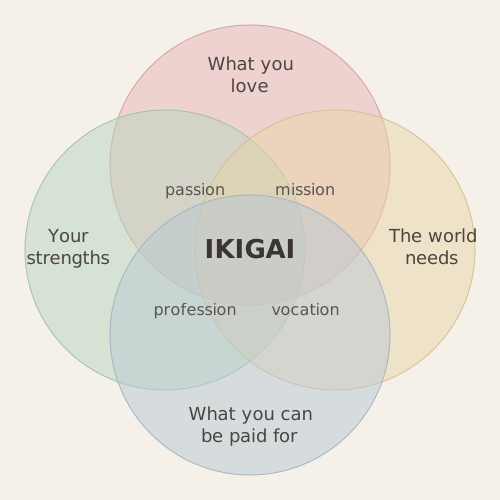
The Four Circles Applied to Cybersecurity
The Intersections
| Intersection | Circles Combined | Result | Risk |
|---|---|---|---|
| Passion | Love + Good At | Enjoyment without income | Hobby, not career |
| Mission | Love + World Needs | Purpose without mastery | Burnout from inadequacy |
| Profession | Good At + Paid For | Competence without passion | Emptiness despite success |
| Vocation | Needs + Paid For | Utility without joy | Feeling replaceable |
| IKIGAI | All Four | Sustainable fulfillment | None |
The 5 Cybersecurity Domains
We mapped the cybersecurity landscape to five domains that cover the full spectrum of security work, have distinct personality/skill profiles, offer clear entry points, and align with the NICE Cybersecurity Workforce Framework.
Developing policies, managing risk, and ensuring regulatory compliance. Strategic thinkers who see the big picture.
Designing secure systems and infrastructure from the ground up. Systems thinkers who love complexity.
Finding weaknesses and understanding adversaries before they strike. Curious minds who love puzzles.
Monitoring, detecting, and responding to threats in real-time. Quick decision-makers who thrive under pressure.
Protecting industrial control systems and critical infrastructure. Safety-conscious with physical-digital mindset.
Assessment Design Methodology
Question Distribution
12 questions total organized into 4 IKIGAI sections:
- PASSION (What You Love) — 3 questions
- SKILLS (What You're Good At) — 3 questions
- MARKET (What World Needs) — 3 questions
- PURPOSE (What Pays) — 3 questions
Why 12 Questions?
- Minimum for validity — Covers 4 sections × 5 domains adequately
- Maximum for engagement — 5 minutes is the attention threshold
- Balanced coverage — 3 per section prevents single-question bias
- Mobile-friendly — Completeable on phone during workshop breaks
Question Design Principles
- Scenario-based, not abstract — Concrete situations, not personality labels
- 5 options per question — Maps directly to 5 domains
- No "wrong" answers — All options are legitimate preferences
- Equal social desirability — No option is clearly "better"
- Mutually exclusive — Options don't overlap significantly
Question Structure & Intent
Section 1: PASSION (What You Love)
These questions identify what energizes participants—activities they'd do even without external rewards.
| Question | Intent |
|---|---|
| "Which type of work excites you most?" | Identifies core work preference at fundamental level |
| "What do you enjoy doing in your free time?" | Reveals intrinsic interests outside work context |
| "Which scenario sounds most appealing?" | Tests reaction to high-stakes scenarios per domain |
Section 2: SKILLS (What You're Good At)
These questions identify natural talents and developed abilities where participants excel with less effort.
| Question | Intent |
|---|---|
| "Which skill comes most naturally to you?" | Identifies innate strengths to leverage |
| "What best describes your communication style?" | Communication is universal; reveals domain-aligned style |
| "How would colleagues describe your strength?" | External perception often reveals undervalued strengths |
Section 3: MARKET (What the World Needs)
These questions align participants with industry demand and emerging needs.
Section 4: PURPOSE (What You Can Be Paid For)
These questions ensure alignment with practical career considerations—passion without sustainability leads to burnout.
Scoring & Weighting Logic
Weight Values
Each option assigns weights to all 5 domains on a 1-5 scale:
- 5 = Strong alignment (primary domain for this option)
- 3 = Moderate alignment (secondary relevance)
- 2 = Weak alignment (tangential relevance)
- 1 = Minimal alignment (not relevant)
Score Calculation
For each domain, the score is calculated as the sum of weights from all 12 answered questions, then normalized to a percentage (max possible = 60 points per domain).
Why Top 2 Results?
- Primary match — Strongest alignment, most likely fit
- Secondary match — Alternative path, often complementary
- Presenting only 1 feels limiting
- Presenting all 5 creates decision paralysis
Results Interpretation
Score Bands
Result Patterns
One Dominant Domain (80%+, others below 50%)
- Clear direction, focused career path
- May miss cross-domain opportunities
Two Strong Domains (both 70%+)
- Complementary strengths, consider hybrid roles
- Example: GRC + Architecture = Security Program Manager
Flat Profile (all domains 50-60%)
- Generalist orientation
- Consider consulting or management paths